
Creating Calm Connections
A Daily Somatic Calming and Sensory Regulation Routine (For All Ages)

Are you or your child training your brain to be agitated, fearful, or angry? Quite possibly. Practice makes permanent. The more often the brain practices being agitated, fearful, or angry, the more neural connections are formed and strengthened, and the better it gets at doing those things. The same is true for calm and regulated. Most people think of regulation as something you do only when things fall apart. But your nervous system works more like your teeth. You do not wait for a cavity to brush. You brush every day to prevent problems and keep things clean.
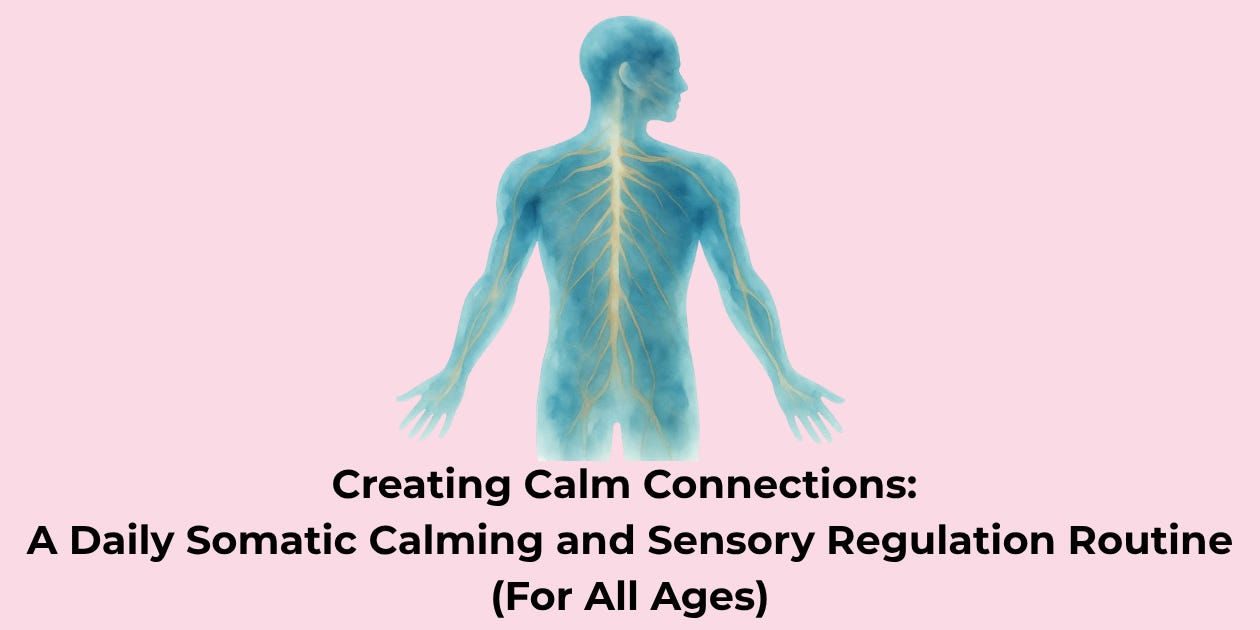
A sensory routine works the same way. Daily practice keeps your system regulated. It prevents stress from building up. It strengthens the pathways your brain uses to calm down. And just like brushing when you feel something stuck on your teeth, you can use this routine any time you notice tension, overwhelm, or sensory overload.
In occupational therapy, this is often called a sensory diet. In the trauma and nervous system world, it is called somatic practice. Both describe the same principle: the body needs daily input to stay regulated.
Not just when things go wrong, but to prevent things from going wrong in the first place.
This matters because the nervous system is a bottom up system. The body sends far more information to the brain than the brain sends to the body. You cannot talk your way into calm. You cannot logic your way out of overwhelm. You cannot reason your way out of a meltdown, yours or your child’s.
You have to speak to the body first.
The body shifts, then the brain follows.
These activities are specifically designed to work with the way the nervous system shifts between activation and calm. The routine starts with Release activities because the body must offload extra energy before it can settle. It moves next into Ground activities because deep pressure and muscle activation give the brain strong proprioceptive signals that create stability and safety. It ends with Regulate activities because slow breathing, humming, and vibration activate the vagus nerve, the body’s main calming pathway. This order follows the natural sequence the nervous system uses to move from stress to regulation: first release energy, then stabilize the body, then shift into calm.
You can use this routine to regulate yourself, help your child build a daily sensory diet, or guide a whole classroom through a shared calming practice. Doing it together makes it even more effective because connection strengthens regulation, and nervous systems are contagious: a regulated adult helps a child regulate faster, and a regulated group helps everyone settle more easily.
Do each activity for at least 2 minutes. The nervous system needs 90 to 120 seconds of consistent sensory input to shift out of stress mode and into regulation, so 2 minutes per category ensures the brain has enough time to register the signal and respond.
Optional add calming music to further support the nervous system such as Marconi Union’s Weightless, or music from the Safe and Sound Protocol which are evidenced based ways to increase felt safety. Songs with affirmations are also incredibly effective.
Below is the full daily 6 minute routine, along with the neuroscience behind why it works.
Why Somatic Activities and Sensory Diets Work
Somatic activities and sensory diets are not trends. They are grounded in how the brain and body communicate.
The nervous system is constantly gathering information from:
muscles
joints
skin
breath
vibration
movement
internal organs
This information travels through the brainstem and limbic system before it ever reaches the thinking brain. That means regulation is a body‑first process, not a cognitive one.
Somatic activities work because they:
Reduce stored activation. Stress that is not discharged becomes muscle tension, irritability, impulsivity, and emotional reactivity. Movement and vibration release that stored activation.
Strengthen proprioceptive and interoceptive pathways. These pathways tell the brain where the body is and what it feels like. When they are strong, the brain feels safer and more organized.
Improve vagal tone. The vagus nerve is the body’s main calming pathway. Breath, humming, and vibration strengthen its ability to bring the system back into calm.
Build regulation capacity. Just like muscles, regulation pathways grow stronger with repetition. Daily practice builds a nervous system that recovers faster and holds stress less tightly.
Support co‑regulation. When one person’s nervous system becomes calmer, the people around them feel that shift. Regulation spreads through connection.
This is why sensory diets are not just for kids with sensory needs. They are for anyone with a nervous system.
How Daily Sensory Practice Improves Behavior, Relationships, and Brain Function
Daily somatic practice creates changes that ripple outward into every part of life.
Better Behavior
When the nervous system is overloaded, behavior becomes reactive. Kids look “defiant,” “dramatic,” or “out of control,” but the root is often physiological.
Daily sensory input:
lowers baseline stress
reduces impulsivity
increases frustration tolerance
improves transitions
decreases meltdowns and shutdowns
A regulated body makes regulated behavior possible.
Better Relationships
When the body feels safe, connection becomes easier.
Daily practice supports:
more patience
more empathy
more flexibility
more attunement
more capacity to listen
Parents and children begin responding to each other instead of reacting at each other. This is where relationships soften.
Better Brain Function
Regulation is the foundation of executive function. When the nervous system is calm enough to access the prefrontal cortex, you see improvements in:
attention
working memory
planning
emotional control
problem solving
social skills
A regulated brain learns better, communicates better, and thinks more clearly.
This is why daily sensory practice is not “extra.” It is foundational.
1. RELEASE: Emptying the Stress Bucket
When the body is activated, the sympathetic nervous system floods muscles with energy. If that energy is not used, it becomes internal pressure. Release activities give the body a way to discharge that pressure.
These movements activate the vestibular system, motor cortex, and cerebellum, all of which help reset the stress response.
Full Body Shakeout
Shake your whole body hard and fast from hands to arms to torso to legs.
Why it works: Rapid shaking disrupts tension patterns and sends a reset signal through the motor system.
Playful ideas:
Shake off water like a dog.
Pretend you are covered in glitter and trying to shake it all off.
Imagine you walked through a spiderweb and need to shake it away.
Shake like popcorn kernels popping.
Pretend you are trying to shake off sticky slime.
If this work matters to you, consider becoming a paid subscriber. Your support keeps this guidance accessible for the adults who want to understand children more deeply so they can show up with clarity, compassion, and skill. When more adults know better, more children get what they need to thrive.
Paid subscribers receive one implementation focused post each week with practical tools, scripts, scaffolding examples, and step by step guidance rooted in behavioral regulation, executive function, and neurodiversity affirming practice. Each post is designed to help you meet your child where they are and guide them toward being kind and successful in the way that fits them.
I support the grown ups who show up for kids every day. Parents, teachers, therapists, and the unofficial aunt who isn’t related but absolutely counts. No matter your role, if you guide kids, I’ve got you. Welcome in. Don’t mind the mess. I’ve got tea or a Rockstar. I’ll put on some music. Let’s get to work.
